
An interview with Author SAAD Z HOSSAIN on DHAKA SESSIONS
Transcribed by Aleesa Azim
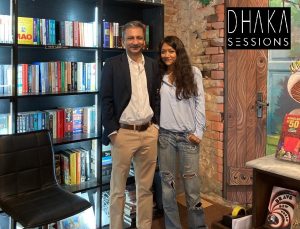
DHAKA SESSIONS powered by bKash was honoured to feature author of three published books and numerous short stories, and two upcoming novels, the master story teller Saad Z. Hossain.
Saad is a Bangladeshi author who writes in English with a unique blend of fantasy, sci-fi and black comedy. His books have been included in yearend lists as must reads in media such as Scroll.in and Financial Times. His short story has appeared alongside Neil Gaiman and several other big hitters. His books ‘Escape from Baghdad’ and ‘Djinn City’ have both been translated into French by Agullo Editions. Both books were finalist in the Grand Prix de L’imaginaire. Djinn City, translated into the French by Jean Francois Le Ruyet, won the award for his work on the book in 2021. ‘The Gurkha and the Lord of Tuesday’ has received critical acclaim and was the finalist for Locus Awards as well as IGNYTE Awards 2020 by Fiyahcon.
Saad was interviewed by Shazia Omar, the author of ‘Like a Diamond in the Sky’ (2009), ‘Intentional Smile: A Girl’s Guide to Positive Living’ (2013), and ‘Dark Diamond’ (2016).
Shazia Omar (SO): Hello and welcome to Dhaka Sessions: The Interviews. This is an amazing new platform where Chotu Khan (Producer of Dhaka Sessions) is showcasing the arts and culture of Bangladesh and Dhaka city. So many of us don’t even know our own writers and artists and musicians, so I think this is an exciting space. Today we have with us prominent writer, award winner, author of numerous science fiction novels- and if you haven’t read his books you’ve got to pick them up – I’d like to welcome Saad Z Hossain! Hi Saad.
Saad Z Hossain (SZH): Hello.
SO: So today we’re here to talk about your books and talk about writing and reading in Bangladesh. I’d like to begin with asking you: how has it been over the pandemic, writing, and reading?
SZH: I guess writing is such a fragile mental state, like everything has to be right for something creative to happen, and not the kind of dismal situation that we’re in with the pandemic. It really doesn’t excite any kind of… you know… emotional response, which is what kind of drives writing. When you have an emotional need to say something, that’s when you start producing the words. But if you have nothing to say, and you’re just killing time, then it’s not really a good space to write. Anything! Not any genre in particular, but you know if you’re a poet, for example – where would you get that angst from, you know?
SO: I think you’re right. It’s been such a dark time; it’s been really hard to engage in something creative, and to nurture the kind of storylines you would want to be in a really good headspace. Have you been reading?
SZH: Yeah, a little bit, but mostly I’ve just been gaming.
SO: Gaming! Alright, what are your top three games?
SZH: FIFA, I play a fair amount of football with the kids. Then some NBA. We have this online game called Uncharted 4. It’s like a third-person shooter. You can play on teams, and there’s five or six of us who play online. Some are friends in London, and some here.
SO: You kill each other?
SZH: Yeah, yeah, you basically kill each other. And then you’re talking on the mic also, so it’s like a virtual hangout with killing, of course!
SO: That’s nice. So if you (audience/reader) haven’t read Saad yet, you might be shocked to find there’s always a lot of killing and gore and mayhem –
SZH: There’s not… there’s precious little gore… But you know, science fiction is going to have a degree of violence, which is odd; but most genres of fiction have violence. I mean, other than romance.
SO: Right, other than romance.
SZH: I think sex and violence are what sells, basically.
SO: Right, that’s what captures the market. So can you tell us a little bit about this anthology, the ‘Djinn Falls in Love’?
SZH: So I started writing about djinns… that was kind of my topic, right? And in English, djinns are not particularly well covered. In, like, western literature it’s not a big thing. Neil Gaiman wrote a little bit about djinns in the other chapter and –
SO: Let me just repeat that – you and Neil Gaiman in the same anthology? Woohoo!
SZH: That was accidental, yeah. No, so these guys are basically a big imprint, Solaris, I think. And they wanted to put together a collection of djinn stories, and then they found out of course that actual western authors really don’t write about djinns. It’s not part of their culture. Western fantasy and science fiction come from a Norse background, right? So it’s not even Mediterranean. It’s not like Greek mythology. It’s almost purely Norse mythology.
SO: That’s like, dragons and knights?
SZH: Yeah, the basic mythology that they’re based on, which Tolkien kind of used and which everybody else uses. So you’ve got the fairy world, which is like the elves, and you’ve got the dwarves, which are straight from Norse Mythology. It’s quite dark, it’s based on winter, you’ve got some tones from Beowulf, so all of this is kind of the cultural foundation of their whole science fiction and fantasy genre of western literature. But ours wouldn’t be that, even though, when we start writing in English, we do start using elves and orcs, because that’s what we’ve also grown up with. But that’s not necessarily our cultural background, so it’s not specifically natural to us, right? So there’s a bit of tension because you don’t have that ingrained in you. You kind of get it from reading. What’s more natural for us is djinns. So anyway, when I thought about it, I was like, you know, I shouldn’t be writing about elves and fairies and dwarves – I should be writing about djinns because that is the mythology we have. And that’s beautiful. Like why would I write about vampires? Vampires are Eastern European mythology. And even though I love vampires, it becomes derivative. So, you know, we should basically find our own vampires. We should find our own monsters, and we have so many just lying around that are underutilized.
SO: Do we? What else do we have?
SZH: We have the entire Mahabharata, which is just amazing. Ten epic stories in one giant book. It’s bigger than the Iliad. It’s bigger than the Odyssey. It’s basically all of the Western kind of Homeric epics and Beowulf, and if you put it all together, it would still fit inside the Mahabharata. This is a giant thing, and it’s got amazing stories and characters, and that’s part of our culture.
SO: Yes, in India a lot of books are coming out around the Mahabharata.
SZH: Yeah, now they’re mining! This is a mythology that you can just mine, like, you can use this continuously.
SO: Right.
SZH: The daunting thing is that it’s unfamiliar to western audiences and, ultimately, when you write in English, you’re looking for a publisher in America or the UK. And when you start flinging around a lot of foreign words and concepts and surahs and demons, after a certain point, the mind just stops, right? It’s too difficult (for them). So you have to kind of introduce these things and then let them become part of the culture…
SO: So, that’s interesting. You say that the western reader, maybe, or publishers specifically are not familiar with our mythology so much? But this anthology, are all stories about djinn?
SZH: So, because of (Neil) Gaiman and because of various other stories like Aladdin, djinns are kind of accessible. And also, djinns come from the Middle East, which is a Mediterranean space. So it’s kind of geographically, culturally, and mentally more accessible, I feel, to Europe and America than the Far East and deep India, which is a kind of separate world. It’s a bit like, you know, when you read Chinese mythology, or you read Chinese fantasy, and it’s about all these references to Chinese myths that we don’t know anything about. After a while, you’re just like, “okay I’m not getting it”. And I think that’s part of the issue; but with djinns, luckily there was enough material. They gathered together all the writers that wrote djinn stories and by some luck, they asked me to do a story. And the thing did really well.
SO: Nice. I hope we can get a copy of this book [The Djinn Falls in Love & Other Stories, 2017] at Bookworm sometime soon.
SZH: Bookworm is the best bookstore in town, as you can see.
SO: Absolutely, we love Bookworm.
SZH: This is our oldest bookstore, right? But it’s also run by people who just like books. I mean, they have a genuine fondness for books, which is different from having a bookstore where you’re going to have a bunch of commercial bestsellers and magazines. And then eventually you’re going to have toys, and then eventually you’ll have, like, a mishtir dokan [Sweets shop], or something, and pretty soon the books will be in one corner. Which has happened before.
SO: We’ve seen this trajectory.
SZH: Suddenly there’s a Coffee World taken over eighty percent of your bookstore. But these guys have been around for a long time, and it worked.
SO: And it’s so beautiful! Just coming back here today, seeing how much has changed, seeing the new spaces and how they’re using it – I just love the feeling of being around books.
SZH: Yeah, it’s actually gotten bigger, which is amazing, because the big fear is that bookstores are going to shrink. That’s always a fear, for both of us, I imagine. You see, especially in bad economic times, the first things that go are bookstores and publishers, because it’s a luxury. It’s like a labour of love. Nobody here in this entire chain is getting rich. It’s really got to be about quality.
SO: Why do we do it? Why do you write?
SZH: It’s about excellence. It’s about being as good as you can. As a publisher, could you produce a book physically that looks as good as this [The Best Science Fiction and Fantasy of the Year, Volume Twelve]? This is published by Solaris. This is an imprint for science fiction, a top imprint. This is The Best Science Fiction and Fantasy of the Year, volume twelve. They’ve made twelve of these! Every year they come out with one of these and it’s got stories by everybody.
SO: Can you tell us about the story?
SZH: Well, that short story was about a cook, actually. It’s set in the future when people don’t eat cooked food anymore. They have super processed food and it’s all made from algae and flavouring, and there’s kind of a 3D printer kitchen that spits out whatever you want. If you want biryani it spits out biryani. But the ingredients are all the same. You’re not using raw ingredients, you’re using synthesized taste.
SO: Ahhh. Okay.
SZH: Everybody’s happy with this because it’s hygienic and it’s not clogging up your arteries and killing you or whatever. Except this guy is a cook, and he’s a talented cook. He roams around the abandoned parts of the city, which have been abandoned for various reasons, and there are very poor people there. He actually finds live food and he tries to cook. He tries to make a restaurant. He sees that all these people – they love the food but they also miss the community feeling of gathering and finding different ingredients. Of course, in the end, everybody dies and the restaurant is shut down!
SO: Nice.
SZH: It was a short story, so I couldn’t write the rest of it.
SO: There’s something so poignant about that, how we as people love community. I just feel like in the pandemic, having been so isolated, something about that need for human engagement and community sort of shows up. When you have this sort of dark, bleak future…
SZH: Yeah, exactly. You write dystopian fiction and-
SO: And now it becomes real!
SZH: This is dystopian! You couldn’t make this up! 2019 you’re partying and you’re doing whatever the hell you want, and suddenly 2020 you’re like-
SO: Trapped at home.
SZH: It’s like, more than three people in a room? We can’t have this.
SO: I mean, this is great, that we get to have a chance to have a conversation [here] and it’s going to be on YouTube. Dhaka Sessions is bringing us all this music and literature, but yeah, I feel like we’re all missing the Lit Fest [dhakalitfest.com] this year, for example. It didn’t happen and that’s been something we as writers always looked forward to.
SZH: Yeah, yeah exactly.
SO: There’s the stand with the fuchka and juice-
SZH: And you get to meet all the other writers, whom you know, or Chotu [Producer of Dhaka Sessions] who doesn’t read or write; but we get to meet him too, because there’s always musicians hanging about. Just in case, you know, somebody happens to want a song. He’ll burst out like Superman from the bushes and he’ll sing.
SO: Serenade you.
SZH: Which he’s done! I’ve seen him do that. Talented man, jumping out of bushes.
SO: That’s right.
SZH: No, but you miss that feeling that you’re part of a community of other artists, writers, painters, poets, and you don’t get that right? Because most of the time you were working in a vacuum. I mean, we definitely work in a vacuum, right? At most, we meet up once a month, whatever. Chotu, or musicians even, they probably work in a vacuum too.
SO: At least they have the band, and rehearse.
SZH: Yeah, but when they’re writing the song or practicing, it’s not in front of the crowd normally. So I think in the end, they’re unique periods when you meet the rest of the community, just to get an idea of “Okay, everybody’s still out there” and work is being done. It’s like, other people are working, fun things are happening and you can collaborate with somebody you love. If you can’t meet anybody, then you can’t collaborate. Then a lot of things are lost, because then you’re kind of just writing in a vacuum.
SO: I mean, even writing – the whole thing is storytelling; it’s sharing your ideas with someone. It’s also a dialogue. [Anyway] I’ve got a few questions for you here- which comes first, plot or character? We’re exploring your writing process.
SZH: For everybody, it should be the character. It really should be, because plot first of all- you can’t interest people with just plot. If the characters aren’t good then I don’t think people are going to read it. Whereas if the characters are good but there’s no plot, people will still read it. It’s kind of like a mental journey of that character; and when you read, I think you want to lose yourself in somebody else’s mind. It’s escapism. It’s not so much like: “I want to gain information.” From fiction, you’re not trying to learn stuff most of the time. You’re trying to actually lose yourself, and whatever learning you do is by osmosis, through the lens of the character you’re reading. So if you don’t have a good character, what’s the point? If it’s not an interesting character, what’s the point? And it also has to be a true character, in the sense that the characters have to have a kind of internal logic, which is something I realized after a while, after practice of writing lots of characters. A character can be flawed but it can’t be illogical to the mechanics of how that person makes decisions. Once you write a character and you put these things in, for example, if my character is very aggressive, at any sign of confrontation he will jump in and start a fight. Then you can’t have a scene later on where he runs away. That person would be incapable of this act. His pride demands that he utays there and fights. So that’s what I’m talking about -, internal logic. It’s not a rational thing to do in any situation, but it’s logical for that person.
SO: Right.
SZH: But once you make a character like that, and you make all your characters like that, then the story writes itself. They’re forced to react in certain ways, otherwise, they would be wrong. It wouldn’t fit there. It’s like a real person. If you know somebody you know that this is how they would react – when I’m reading at least, I’m that person. I need to identify with one of the people in the book.
SO: I think I’ve read all of your books and one of my favorite characters is from Gurkha and the Lord of Tuesday. The djinn that you write up in that story is just so funny and always true to his character and you know what he’s going to do, and it’s so hilarious. You have always written with a lot of humour. But then this new book you have coming up, Kundo- such a different character! Much more in touch with his emotions, he’s hurt, he’s suffering… So, how is it that you are able to embody such different characters?
SZH: I prefer writing the buffoonish characters. They’re more fun to write. But, you can’t have a story with only jokes, you know? There has to be some kind of emotional growth at some point. The Kundo story, which was supposed to come out this year but got pushed back because of the pandemic, is also by Tor [publisher], the same people who published the Gurkha.
SO: Viewers, if you don’t know about Tor look it up [tor.com]. Best publishers of science fiction. So modest Saad here has been picked up by the top of the top.
SZH: They published Dragonlance, which is a big fantasy series. The Kundo story is about a guy who wakes up in a wrecked city, which is Chittagong.
SO: In the future.
SZH: Well, I imagine it right now as wrecked. It’s about- Chittagong has drowned. Which is happening right now.
SO: For sure, climate change…
SZH: Yeah, climate change is going to take care of this city by itself. We don’t even have to do anything. This is going down anyway. We’re at that stage where human governance is not good enough. It’s important to keep people alive and keep the electricity going, the air clean and the water clean, and these are all becoming insurmountable problems. I think at some point you would hand that part over to artificial intelligence. So you would create a governor for the city, an AI and give them all the problems. They would resource allocate and figure out the best way to do it, without corruption and favouritism, and incompetence. Basically, human incompetence is going to get us killed. We’re at that stage where the climate is revolting and we have no solution. We’re still bickering about how much oil to burn. It’s a ludicrous situation.
SO: It’s incompetence and greed-
SZH: And short-sightedness, and the idea that “Look, I’m only going live another twenty years, so I don’t really give a shit about something fifty years from now” – it’s that kind of story in almost a post-apocalyptic situation. But there’s no victory, you know. It’s more of an exploration of the aftermath of a disaster.
SO: So have you ever had a djinn experience?
SZH: No. No, I haven’t. The funny thing is that’s actually helped me, I think. If you have had those experiences and then you believe them because the djinn is in the Quran, right? So for us, it’s fact. There’s a surah, Al-Jinn.
SO: Does that make this sort of tricky ground, to be writing something that’s live mythology still?
SZH: No. No because I’m clearly a fiction writer. I’m not a documentarian. I’m not writing historical fiction. Everything is made up. The tricky part is that I don’t necessarily want the djinn from the Arabic culture. I don’t want the djinn that haunts you for no reason, or hangs out in trees. I want a different kind of djinn that I can use. I made up the history of the djinn and the culture of the djinn. For example, my djinns love litigation. They have a lot of laws and rules.
SO: A rule-based society.
SZH: Well, they take each other to court. They have a very long culture. They’re basically immortal. We’re not sure if they die of old age, so imagine these beings whose lives last for thousands of years. They would have had to develop some kind of a culture, even if they’re solitary creatures. Why don’t they have a complex culture? Why are they still about messing with random villagers? Is that fun for them? I don’t know. They must have some other pursuits. The other thing I had for them which made sense to me was boredom. They’re essentially very bored, because their life is long, and they have their own kind of political struggles and competition, but they also suffer from boredom. I mean, we also suffer from boredom, and our lives are terribly short. You have to take certain licenses sometimes with mythology.
SO: If you had any superpower, what would it be?
SZH: Superpowers should be really specific. It should be well defined.
SO: Not just like, “strong”.
SZH: Right. I want to be able to copy the abilities of anybody within a certain radius, let’s say a hundred meters or so.
SO: But then you have to find other talented people.
SZH: Yeah exactly. So if you’re hanging around with a bunch of talentless hacks, then that’s the best you’re going to be. If you’re next to Usain Bolt, you’d be able to run as fast as him! So that’s a great power.
SO: So you can challenge anybody at what they’re good at.
SZH: Yeah, exactly. If Chotu’s on stage, I could suddenly be at the other end and grab the mic and be just as good as him. But better, because you know, I’m better looking!
SO: Awww. You’re both kind of cute.
SZH: Yeah, that would be an awesome power.
SO: You want that just so you can rile up people that are proud of their powers?
SZH: No, but, think about it, right? In any situation, you can steal the thunder from whoever you’re with.
SO: You just want to steal everyone’s thunder!
SZH: They’d just be like, “Where did this guy come from?”
SO: You could do everything. I like that. That’s a pretty good superpower. I was going to say time travel, but this is actually much better.
SZH: See, if you had time travel, I could time travel too! Just nick all your stuff.
SO: So my next question for you is: what’s more important, the story or the storyteller?
SZH: It’s a difficult question, because before you would say the storyteller, because you think that the creative person is more important. They’re going to give you more than one story. But now we’re in a revisionist era where we’re looking back at our old heroes in literature and finding out that they used to own slaves, or used to be terrible misogynists.
SO: The storytellers?
SZH: Yeah, as human beings, there were awful human beings, and some of it was the product of the era they were in. But that’s not acceptable. Right now, if you happen to be, or have been somebody who was into slavery, I cannot look beyond that. I don’t care if slavery was rampant then. Now you look at it and you’re like, “I still love the story, but I hate this person.”
SO: That’s a painful dilemma.
SZH: It’s not like they were just casually racist. They were expounding their racist views in other platforms. So then you’re like “Okay, you’re really part of the problem.” The story is something you grew up within childhood, or you read it when you were a teenager. Those stories are important to you. They form your mental landscape, so you have to separate them. I think a more nuanced way of looking at this is saying “Look, I’ll take the book, but leave the author.”
SO: So we have to be quite discerning as readers, then.
SZH: Yeah, but who has time for that? Who wants to do that? I mean, books are about escapism. I read to get away from these damn things. I don’t want to research the bloody author and find out what kind of music they like and then fight over that. I mean, who cares?
SO: alright, so my last question for you is, since we’re here at a bookshop, and there’s copies of your books all over the place, if you were to write the book of your life, what would the title be?
SZH: It’s indulgence to write about yourself, yourself, right. But that’s not to say you’re not mining your life for your work, because you are. Anything you write, like if you’re writing about your character being angry, you’re actually processing when you were angry. How else would you know what that feeling is like? So everything comes from your experiences. Characters come from other people. You take bits and pieces, like “Oh yeah, this is a character that’s like Shazia. I’m going to give her a couple of gestures that remind me of her.” That doesn’t come across to the reader, but it’s being used anyway. So it’s like all writing is autobiographical in that way. But, nobody cares enough about your life to actually delve into it and find out, which is good.
SO: Great. All right, thank you Saad and thank you, viewers, for joining us. If you haven’t subscribed already please go on down, hit subscribe. Join Dhaka Sessions [youtube.com/c/dhakasessions] for more of these upcoming music events and interviews with artists and actors and writers. Come to Bookworm and check out books by me, Shazia Omar, and Saad Z. Hossain. Pick up local authors and international authors – it’s all here in this beautiful cozy bookshop, and stay well!
# NeilGaiman #AgulloEditions #LocusAwards #thebestsciencefictionandfantasy #dhakalitfest #djinn #

