
The indomitable SADAF SAAZ Interview
transcribed by Aleesa Azim
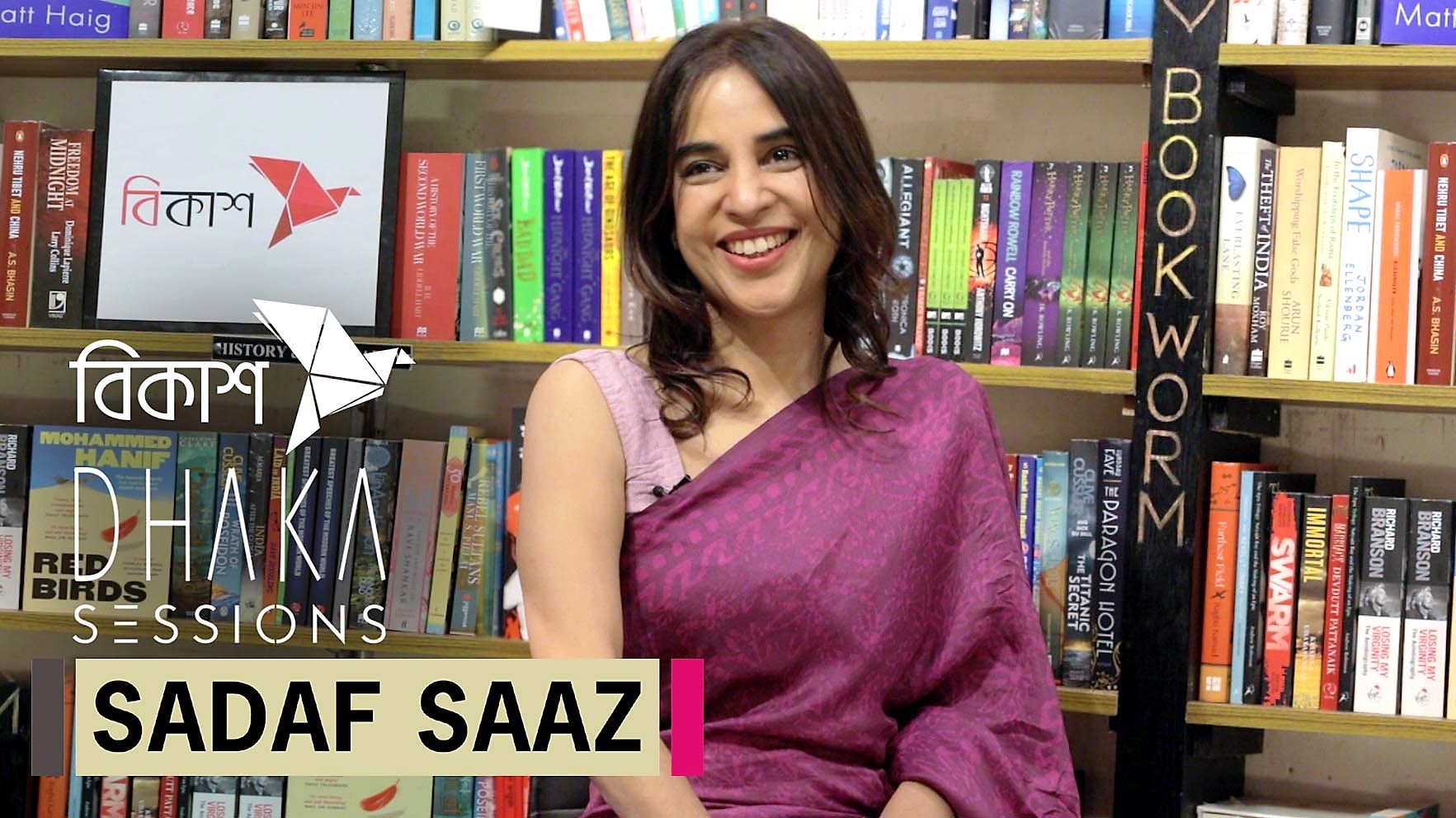
The director and producer of Dhaka Lit Fest, Sadaf Saaz was invited for an
interview on Dhaka Sessions on 31 st of October 2021 at The Bookworm
bookshop in Dhaka. A poet, writer, activist, advocate for women’s rights,
entrepreneur, and social worker, Sadaf wears many hats; and she wears them all
well. She brings positive international exposure for our literary culture and
country. Sadaf makes us proud.
Sadaf Saaz (henceforth SS) was interviewed by Chotu Khan (henceforth CK),
the producer of Dhaka Sessions powered by bKash.
CK: So it’s 1984. Prince is out with Purple Rain. Thriller by Michael Jackson is
out; Duran Duran is out with Reflex; Spandau Ballet, Human League – the British
charts are just dominating the music scene. They’re in the hearts of every
teenager. And you move from England to Chittagong in the height of everything
that’s going on! Who does that? Tell us about this experience.
SS: Oh my god, it was such a culture shock. I was sixteen and I moved from
Cambridge to Chittagong. And in those days, you know, it was my father going
back to the homeland.
CK: To the roots?
SS: You know, he had a dream for many years and finally acted on it. Of course,
I didn’t want to leave at all. I enrolled in a Chittagong government college.
CK: So, Bangla medium? Full English to this; it couldn’t be more poles apart.
SS: Exactly, and I didn’t know Bangla too well back then. So it was really like
being thrown in the deep end; and it’s not just the language – it’s the whole
culture. So your reference points, as you were saying, all the music and the
jokes, and what you talk about with people – in Chittagong those days I had to
learn to speak Bangla. I learned it really quickly.
CK: You didn’t have a choice!
SS: Chittagong College was, as I said, a government college that was so
different from the world I grew up in.
CK: So what were the barriers? I mean, one was language and two culture, but
how much did it take for you to say, “okay, this is my reality?” When did that set
in, because I’m sure you were thinking, “Ahh, I’m going back [to England].”
SS: My father had such a deep conviction and dream to make it in Bangladesh,
and kind of brainwashed us I guess. Actually, the interesting thing was, so much
of what we had grown up with was Bangla songs and culture, even though we
had grown up in Cambridge. I was just remembering the other day, I think the
only other brown person in my entire school was probably from Sri Lanka.
CK: And he didn’t speak Bangla.
SS: Exactly, and so I think that it was something very interesting that happened
to me in those two years. It was difficult to make friends, but I was very outgoing
and my father also didn’t have this idea of “you can’t go to this person’s house”,
“you can’t go there”. So in that sense I had much more freedom than other
people that I knew. I think that the interesting thing was that my father
encouraged me to mix with all kinds of people from all kinds of different
backgrounds. There was a vibrant cultural scene in Chittagong then. I’d grown up
listening to Nazrul and Rabindranath’s songs and folk songs, and my father used
to play them all the time. I remember my aunt used to come over and we used to
learn singing and dancing. We used to do little plays at home. So I had a kind of
connection. It was all very familiar and it was only years later that I understood,
for example, what the words were saying or understood the poetry. There was
something that was very special that happened to me in those two or three years
that I was in Chittagong – a connection with something very deep inside me, and
there was this kind of intangible engagement, which I still can’t explain. I still
wanted to go abroad, I wanted to study and go to Cambridge University, but I had
this dream that I would come back [to Bangladesh]. I had this very idealistic idea
of giving something back to Bangladesh.
CK: And you are. Dream is coming true. You mentioned your father quite a bit,
and rightfully so. Your father Mr. Jamal Nazrul Islam was one of the most
renowned physicists of the 20th century. He’s been cited with names like Richard
Feynman and Stephen Hawking. So, what was it like, being in the company of
such a man?
SS: I think one of the things he instilled in me from a very young age was this
insatiable quest for knowledge, his curiosity for all sorts of things, not just
physics. That, I think, has stayed with me.
CK: From writing poetry, organizing and even participating in theatre, organizing
the Dhaka Lit Fest, running successful businesses, you certainly wear many
hats. What are you most passionate about?
SS: That’s a tough one.
CK: Go for it! Nobody said this [interview] was going to be easy.
SS: I think to some extent I’m really passionate about everything I do, which has
been tough, because that’s been something I’ve tried to confine myself,
understanding that you do need to focus on something to take it forward. If you
do too many things, you know, you don’t want to wear yourself thin on every one
of them. So obviously literature and writing and the cultural arena are things I’m
really passionate about. And I love the engagement of young people in Dhaka Lit
Fest, and in the cultural arena; when young people come to the productions we
put on or the events that we do. I think that kind of interaction is something which
is really exciting. You’ll know this; I love the idea of the curating; and when things
just come together and the sparks fly and there’s such a high, you feel that you’re
communicating something that is inspiring. You’re communicating something that
people can really connect to, to their core. That kind of thing really is fantastic.
CK: I don’t read books and here I am, attending every DLF that you’ve done, day
in day out; and here we are in a bookshop, the least likely place for me to be in. I
should be in a record store, not a bookshop! So you’ve definitely inspired me.
SS: I think that is the other exciting thing we’ve tried to do with Dhaka Lit Fest –
bring in people from all kinds of backgrounds and interests, and have that cross-
disciplinary dialogue, discourse, and exposure. I think in Bangladesh now, quite
often, you’ll sort of see the English-speaking or English-medium kids in one kind
of group; then there’s the Bangla medium kids; and there is sort of a divide.
That’s one thing we’ve tried to address. I always try to say that, it’s not just an
English Lit Fest – it is a festival for Dhaka.
CK: And you couldn’t host it at a better place than Bangla Academy! That’s even
more remarkable.
Alright, so you spent your formative years abroad, yet you exemplify our Bengali
culture so well. Here’s a difficult question: what does being Bangladeshi mean to
you?
SS: It is a difficult question. I think Bangladeshi for me is a way to celebrate all
parts of myself. I think one of the key feelings that I have about being
Bangladeshi is this idea of syncretism and pluralism in the sense that I can be
many things, and I’m an amalgamation of them. I think I learned to celebrate that.
I learned to make that work for me.
CK: I think we underestimate as Bangladeshis and in Bangladesh that we are
quite a diverse mix of cultures. Yes, the one fantastic unifying thing is obviously
our language, Bangla. Be it Sylheti, be it Chittagongian, or Dhakaiyya, Bangla is
what unites us. Yet we are very diverse. The food from Chittagong to Sylhet is
quite different, and just as you said, I think it’s beautiful that you are an
amalgamation of all of those pieces, and that’s what makes us all Bangladeshis.
SS: I think that, of course the language is something that unites us. But I think
this land, where throughout the centuries you started with the animist tales and
epics; and then Hinduism and Buddhism and Islam – a very open and embracing
Islam, when we’re talking about the Sufi traditions – it’s something that connects
to something higher in us. I believe that all of these influences that we’ve actually
been able to incorporate have helped make us flourish and have been our
strength as Bangladeshis.
CK: We’re giving, and we take in so much. Like you said, there are all these
cultures coming in, and we’ve taken it and we’ve also given. Be it in language, be
it in food, whatever – it was a beautiful marriage, and I think that we need to come
back to that. We need to be reminded that, that’s what it means to be a
Bangladeshi – that we are an amalgamation. I love that word [amalgamation] you
used.
SS: We do know who we are and we’re proud of our culture; and I’m not talking
about a very prescriptive or dogmatic nationalism. I’m talking about something
much greater. To celebrate the fact that we did have the finest Muslin’s in the
world; the best fabrics in the world were exported all over the world [from here].
We were part of a very vibrant trade route; which again, did so well because of
our warmth and our generosity, and our openness. Openness not just to people
but to ideas.
CK: Coexistence.
SS: …and this idea of culture being very dynamic and fluid and ever-changing.
CK: You studied molecular biology at Cambridge University, and here you are
writing poetry and hosting literary fests. Is there poetry in molecular biology, and
where do you find poetry in your life?
SS: I definitely do think there is poetry in molecular biology, because it’s beautiful
and elegant and it’s got a very strong essence in life. I feel like that is what poetry
is to me, and I actually, out of everything I do, think poetry has been a constant
for me. It’s something that I absolutely love doing and it doesn’t have to be out
there, but to be able to express myself in a way that distills what I’m feeling inside
– I think that is very important to me. It connects all sorts of arts. It connects us to
who we are, and connects us to something higher. I think especially for you and
me, it’s very interesting because there’s one side of us that’s kind of very good at
organizing and the professional side. You have to have that hat where it’s
business and-
CK: “I want it this way!”
SS: Right. But then there’s this other side where you have to be vulnerable.
When you get in touch with your emotions, that’s when you probably are the
most creative. So even when you are doing the logistics and making sure that
everything is on time and on schedule and Plan A B C D is being followed, you
also have to tap into that other side. Otherwise, you’re not going to get the best
results.
CK: You’re a strong advocate of women’s rights. What is one piece of advice that
you would give to your younger self?
SS: I think it’s more or less what I’ve been doing, which is – don’t worry about
what people say. If it’s something you really believe in, go for it. That doesn’t
mean I always get what I want, obviously! I always do what I would like to. When
I have decided that I want to do something, I’ll just do it. I think that there are
certain things that I’ve had to compromise on the way, but those have been
things that I felt were necessary; and I think that, that’s the thing with everything
in life. Being able to do the things you want, or it to be acceptable at the right
time, there are certain things you shouldn’t compromise on, and you absolutely
need to push the boundaries and be out there and be fearless.
CK: I want to talk a little bit about your book of poems, Sari Reams, which comes
with a beautiful CD of music with you reciting your poems over them. Absolutely
brilliant. I loved it. Why this title?
SS: Sari Reams goes back to this idea of the sari connecting the wisdom of
women from the past to who I am today. But also the fact that you can do
anything wearing a sari. It’s a single piece of cloth, and you can wear it in so
many different ways. I feel completely liberated wearing a sari, and I love the fact
that it’s something which is very traditionally ours. But at the same time, we can
take that and do what we like with it, and interpret it in a very contemporary way.
CK: Dhaka Lit Fest has become one of the major events of our social calendar in
Dhaka. Why do you think Dhaka Lit Fest is so successful?
SS: I think that it touches people in ways that they don’t realize. There’s
something very intangible about our connection to our own culture and literature.
A lot of us have been brought up with poetry, or hearing stories from our parents,
or just being exposed to it all around. Bangladeshis love festivals. And I guess,
interacting? I think the other thing is this urge to connect with the outside world,
to connect with the very best, to look at things in different ways and hear about
them in different ways. We love stories; we love coming together, and we actually
love welcoming in people from all over the world and talking to them. We love
finding out about them, and I think all of these things have enabled Dhaka Lit
Fest to go from strength to strength.
CK: So what beliefs or misbeliefs have you been able to challenge by hosting a
literature fest in Dhaka?
SS: Well, the number one challenge was that, you know “nobody’s going to come
here”. Or very few people would want to come to Dhaka. I’m not saying it’s easy.
It is tough; and we have to plan many months ahead. Some people we ask every
single year, for years and years. I mean, Monica Ali I think we asked every single
year since the first festival, and she came to our last one. The other thing was
that Bangladeshis, are they ready for a lit fest?
CK: We’re ready!
SS: I remember the first one we did was at the British Council [Dhaka]. It was a
wonderful occasion. You were there, and I think maybe five or six hundred
people came. There were such vibrant and energized discussions, and panels
and performances, but it was really like, “Sadaf, you can’t expect much more
than 1000 people to come.” That was a kind of a misnomer in itself because, so
much is our art and culture and literature, right? I think the other area which was
challenging or I think that myth we managed to dispel is this idea that there is this
kind of an issue with us as Bangladeshis celebrating a range of things. I think it’s
so Bangladeshi to be able to embrace all of this. I remember one of the panels I
was on, somebody said to me that one of the biggest challenges for
Bangladeshis was, “Am I a Muslim or am I a Bangladeshi?” I think all of us as
Bangladeshis know that that’s like a no-brainer – we’re both. Those of us that are
Muslim, we’re both. I can’t stress this enough. Whichever religion you are or
whichever background you come from, you can be Bangladeshi. That’s the other
thing we tried to completely celebrate at the Lit Fest, to be diverse and inclusive,
and also to push those boundaries for us as well; to embrace contemporary
forms of expression and celebrate young people that are trying to experiment
and innovate.
CK: So how many people now come to Dhaka Lit Fest?
SS: I think we had around thirty thousand coming over three days, and many
more registered.
CK: That’s fantastic. Congratulations! I’ve observed you closely during the DLF,
and there are thousands of people coming to you, including myself, with
comments, congratulations, and complaints] to queries. You remain completely
unshaken, confident, positive, relaxed, and always with a smile. You are energy
in motion. Where does this come from?
SS: This love for life, I guess. I love the team that I work with. I absolutely love
my co-directors, Ahsan and Anis. I love all of my friends and all of Dhaka there. I
think I initially knew everyone, and now I hardly know anyone.
CK: Ten percent, maybe, of thirty thousand?
SS: The stats that we have out, over 80% of people attending are under twenty-
five, which is fabulous. The other thing is that, of course I actually chose to do
this. I put myself under this pressure. The thing that is actually the most
challenging has been raising funds. I think we still don’t have that tradition of
philanthropy, and India actually is far more advanced in that way. They’ve been
able to raise money for a host of literature festivals that happen all over India.
That is still a huge challenge [for us], and I’m hoping that one day it won’t be as
much of a challenge. But of course, that’s a big source of stress.
I get my energy from the crowd, from the other authors who are just so generous
and engaged and excited. The other thing is that, I think it’s a celebration, also, of
the beauty of art and literature in its highest form. So when you see a wonderful
conversation about a work which is really stellar, when you see somebody talking
who has put that effort and that talent and that brilliance into it – I’ve been at
panels where authors who I’ve heard speak many times just say something that
just gives me that paradigm shift to think things in a different way or see the
world in a different way. That is happening on multiple levels. I think that the thing
that excites me the most is when people tell me that they heard something or
saw something or had an interaction that has really added to their view of the
world or how they feel. That is something which is really truly wonderful.
CK: You seem to achieve and succeed in accomplishing whatever you set your
mind to. So what’s playing in your brilliant mind right now? Give me a rundown
on the playlist.
SS: That would be telling. I’m trying to write. I’m writing a novel. I hope to come
up with that. I’m [also] starting a biotech company. So I’m hoping to be able to
make some good progress on that. And I’m actually looking forward to the tenth
edition of our Lit Fest!
CK: Well, that was my last question! The question that everybody’s waiting for –
when is the next Dhaka Lit Fest?
SS: We’re planning it and it’s going to be soon. We’ve got a lot of amazing things
in store. Really want to take it to the next level.
CK: So it’s ‘22? ‘23?
SS: Thinking about it being perhaps just over a year from now. January ‘23.
CK: Okay, super. I’m looking forward to it.
Alright Sadaf, we’ve come to the end. Before we end, is there some way I could
convince you to maybe read one of your poems from this [Sari Reams] beautiful
book?
SS: Oh, thank you. I think I’ll read something which I actually wrote a very long
time ago, but it touches on some of the things we were talking about at the
beginning.
SS:
“Tikli and Glass Bangles” [Saaz, Sadaf, Sari Reams, The University Press
Limited, November 2013, page 6; ISBN 9789845061377]
With tikli and glass bangles
A swish of aanchal with sandal toe
Secured in this jigsaw web
As pieces come and go.
Am I in too deep?
Sometimes not at all
Red paar, zari edge
Black shades and all.
Untamed as sweat glistens
A shake of a tangle with jet mane
I’ve awoken again
To the destiny I foresaw
The dream that I bore
To many who glimpsed
The black and white prints
Bear a chronicle of sorts.
Yes, I’ve emerged
With uncorked gushing froth
Cutting energy raw
Stamping my horizons
And others I saw
With askance purdah eyes
And dormant riches within
I enveloped floating worlds
Till chains became rings.
And freedom another space
As the wilderness grew
I with it too
Yes I’ve ridden cotton clouds from strength
Driven by the call
Black denim, bootlace
Raw silk, and all.
CK: That’s wonderful!
Sadaf, it’s been wonderful having you here [on Dhaka Sessions]. It’s certainly
through your efforts of hosting the DLF at the Bangla Academy that we’re being
able to meet international authors; and our local authors are being read, known,
and acquainted with authors like V S Naipaul, Vikram Seth, William Dalrymple,
Shashi Tharoor and hundreds of others. In the way you are bringing positive
exposure to our culture and literature, be it Bangla or English, we couldn’t be
more proud of you. On behalf of Dhaka Sessions, our crew, our sponsors [bKash
Limited] and our viewers, thank you for the service that you’re doing to our
country. Thank you so much for joining us.
SS: Thank you so much for having me.
[Sadaf Saaz was interviewed on 31 st October 2021 at The Bookworm, Dhaka.]

