
INTERVIEW WITH DANCER TATHOI: DHAKA SESSIONS
Interview Transcribed by Aleesa Azim
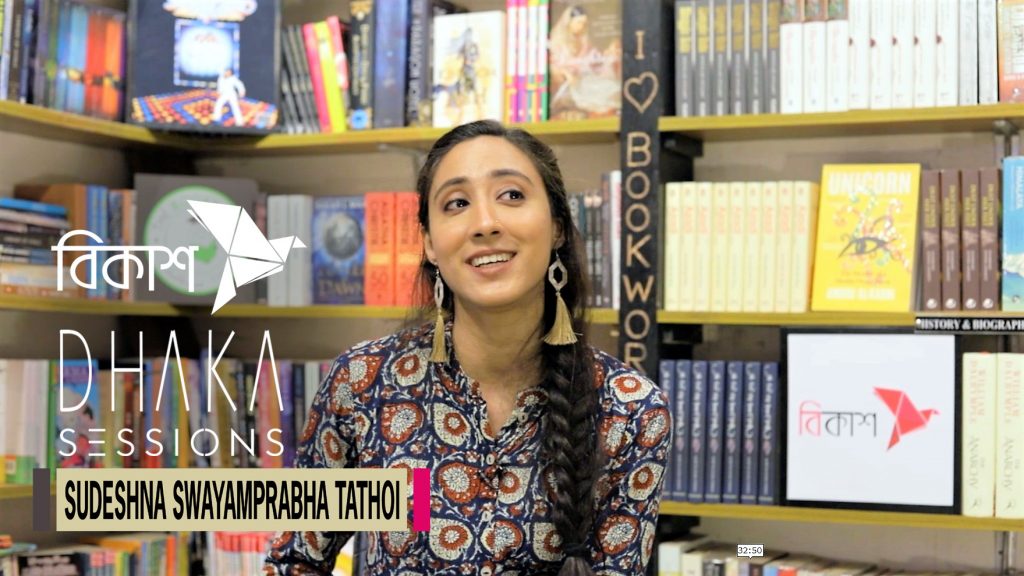
“You reach a point where your dance is near to perfect, but that’s not the goal. The goal is beyond that.”
DHAKA SESSIONS was delighted to have an opportunity to interview Sudeshna Swayamprabha Tathoi, an inspiring young lady who is upholding the strong heritage of Bengali and Indian Classical Dance forms in Bangladesh.
In a world where modern and hip-hop dance seems to be the way-to-go, Tathoi did her Masters at Rabindra Bharati University in Kolkata, and she aced it! She has learnt from the best, and has performed around the world showcasing our heritage. Now she is teaching the dance forms to generations to come, inspiring others to sustain our legacy. Sudeshna Swayamprabha Tathoi makes us proud.
Sudeshna Swayamprabha Tathoi (SST) was interviewed by Chotu Khan (CK), the Producer of DHAKA SESSIONS.
CK: Tathoi, welcome to Dhaka Sessions.
SST: Thank you for inviting me. I’m very happy to be here.
CK: Great. It’s a very casual setting, and I’m so glad that you could make time.
SST: I’m glad that I could come to a platform like Dhaka Sessions that brings out stories of artists, and it’s really nice that bKash is supporting platforms like Dhaka Sessions.
CK: It’s great to have someone, like, you know when you have an idea, and you can find someone who believes in that idea. We found someone like that in bKash. So we’re really happy to have them as our supporters.
Okay, let’s get to it. What about dance do you love?
SST: It’s very difficult to actually explain any specific aspect, because I think dance was inside me even before I was born. In my case, I got into dance very organically, almost unconsciously. At a certain point I realised that I don’t know anything else but dancing. I don’t know what I would do if I wasn’t dancing.
CK: I have to get rid of one of my questions now! ‘What would you be if you weren’t a dancer?”
SST: I really have no idea actually. You have these routines in your day to day life – waking up, eating, bathing. All kinds of daily chores. Dance is something like that to me, a very natural task. Not even a task, it’s as natural as breathing for me. You have to do it to survive.
CK: They say that the best way to know that it’s in-you, especially if you are learning a language, is if you start dreaming in that language – then you know that you are a part of that. It’s almost like that for you.
SST: Absolutely.
CK: You were under the tutelage of a few of the most prominent dance artists in the Indian subcontinent. You were under the apprenticeship of one of the great danseuse Amala Shankar, mother of Ananda Shankar. As a lover of music, that fascinates me. Please tell me about that experience.
SST: I was very fortunate to get that opportunity, actually. My mother got the same opportunity when she was younger, to be under the tutelage of a legendary dancer like Amala Shankar. My mother Sharmila Bandhyopadhay, one of Bangladesh’s well known dancers, was a student of Uday Shankar India Culture Centre from a young age. Seeing Amala dance and learning from her is what ultimately made her decide to pursue dancing. She used to learn singing too, but seeing Amala Shankar’s body language, the way that she expressed herself through her body turned her head completely. Dancing is like a prayer. That’s what she came to understand from her classes.
CK: And was that the same experience you had?
SST: I did classes with Amala Shankar when I was six to seven years old. I became fascinated by dance from seeing the way she expressed herself with her body language, but not in such a philosophical way. There’s technique and physical movement and everything, but at the same time every fibre of your muscles are expressing something. You have that energy that courses through every fibre of your muscle. Creative dance was also something we learned at Uday Shankar Culture Centre, where students had to create dances on their own. You could take inspiration from anywhere. We’re in a bookshop right now. You could take inspiration from the alignment of the books and create a movement from that. It’s imitating any form that we can see visually, what lines you use and what mood you express. I learned that from Amala Shankar.
CK: That’s a really stark difference to how we learn in this country. We’re told to memorise and then vomit it onto the pages.
SST: Exactly.
CK; So do you think that’s where the disconnect is? I feel so privileged, of course, because when I first went abroad to study they told me, “I don’t want to know what’s written in the book. I want to know what you think, what is in your head.” That’s what you experienced over there.
SST: Absolutely. There’s a film about dance, Kalpana. It was made in 1947, but it was so forward thinking. My fascination was born from watching movies like that, and I’m so proud that I got that opportunity, even if it was for a short time. How many people could get an opportunity like that?
CK: By any chance, did you see Ananda Shankar roaming about?
SST: Absolutely I would love to tell that story. My father was doing a PHD around ‘94 or ‘97, and my mother was doing her post graduate in Kolkata. I went to Kolkata for a year too at that time. Ananda Shankar used to live in the same compound as us, about two buildings away. Amala Shankar came to my aunt’s wedding in Chittagong. Our families have a close bond. I feel really good about saying this; I got so much affection from Ananda Shankar when I was young. I used to go and sit in his lap and talk with him.
CK: Now I’m really jealous!
SST: It was a really good relationship and I got a lot of love from him. I didn’t really understand how big that was since I was young then, but I’m so lucky to know these people.
CK: So, who has been your biggest influence?
SST: My mother was my first influence, of course. I couldn’t have come so far without her. Even though I say that dance is in my blood, pursuing that and internalising it is because of her. The biggest influence was at home.
CK: Wonderful. She’ll be very happy to hear that.
What are the most important traits a dancer should have, do you think?
SST: Passion. The way I see it, there’s more to dance than just physical movements and dressing up to perform on stage. It’s all about taking the entire environment around you, feeling what you’re doing and then going for it.
CK: It’s sort of a holistic experience.
SST: Exactly. Even though it may sound different, it kind of feels like a spiritual experience, in the sense that you feel very good when you’re dancing. I think that passion is necessary, and obviously fitness. I don’t want to make my audience feel bad when they’re watching me perform.
CK; You want to be able to give your best.
SST: Practice. It’s the same as any other form of study. If I don’t practice maths, I’ll be out of touch, for example. In the same way, if you don’t practice dance, you won’t develop those reflexes or have that speed, stamina and energy. It slowly reduces.
Also, the thirst to learn more. I’ll never stop learning. I love to learn. I do workshops and master classes whenever I get the opportunity.
And to have an open mind as well.
CK: It’s like music. There’s no wrong music.
SST: I think you should always be open minded and grasp as much as you can in this life.
CK: What form of dance do you enjoy performing the most?
SST: I love performing. Whatever I do, I do with my whole being. Personally, I have had a fascination with Bharatanatyam since I was young. I’m very lucky since I’ve been able to learn Bharatanatyam from a legendary dancer, Professor C V Chandrashekhar. I have idolised him since I was a child. Later I pursued Manipuri, which was my specialisation in university. I also learned it from a young age, under Guru Kalavati Devi, and then later studied under her daughter in university.
CK: Were they welcoming? In my personal experience- when I was in university, a very senior sarod player came to perform. I was very young and I thought I was very cool. I went to receive him on the university’s behalf. He came down from the plane, saw me and just said, “Oh, you’ve come?” and gave me his bag to carry, and started walking. There was another boy from Kolkata with me and we both thought ‘What does he think of himself? He didn’t pay attention to us at all, as if we weren’t people.” Then I watched him perform, and not only that, that day he took us to lunch. He checked into the hotel and asked us “Have you eaten?” We said we hadn’t. He took us to eat. We realised what an amazing human being he was. I realized – this guru, scolding you- it’s not really a scolding. I want you to talk about that.
SST: Exactly. It was for my own good. It’s hard for teachers to scold this generation, they get upset. You need to take it in the sense that, you’re getting the scolding for your own good. You can’t move forward or improve if you don’t get scolded and people just tell you that you’re doing well. My mother never says I dance well. My mother says, “The day I tell you that you danced well is the day you stop dancing.” I’ll stop moving upwards. I got scolded a lot, and I got slaps too. They’d say ‘Why aren’t you doing it like this?’ and come and hit me. It made me realise that I had to take it seriously and give more effort.
CK: When you were under the tutelage of these amazing names, was it a similar experience?
SST: Yes. I got scolded all the time. You might not be able to do something at the moment, but that doesn’t mean you should give up. Why can’t you do it? You have to do it.
CK: They believe in you, also. They know what your limit is.
SST: Absolutely. I think there should always be that balance. You can’t praise them too much. Then we start taking it lightly.
CK: You think, if people are so happy with you right now, what’s the need to improve?
SST: There won’t be any urge to prove myself. I think that’s very necessary in a teacher, to find that balance.
CK: What is the state of the classical dance form in Bangladesh right now?
SST: It has reached a great level. Since the eighties, trained classical dancers have been coming from India and started teaching. Their students took training, and it’s continued over generations. The tradition is still alive. People are very interested in learning classical dance nowadays, be it Bharatanatyam, Manipuri, Odissi, be it Kathak.
CK: I’m really happy to hear this.
SST: The quality is at a really high level, too.
CK: Fantastic. That’s great. How can it be made more relevant internationally? Is there appraisal for it internationally?
SST: Absolutely. Indian classical dance – and of course Bangladesh was a part of the entire subcontinent, and it’s a part of our tradition too. The value of Indian classical dance, and the appreciation, is great around the world. I’ve performed in many places abroad, and they’re always amazed and fascinated when they see this form of dance. This also helps in a way, for younger people to go and learn classical dance forms.
CK: Your mother, Sharmila Banerjee, is one of the most celebrated classical dancers in Bangladesh. Do you see a lot of difference between the dance of the past and the dance of the present in Bangladesh?
SST: I see differences in the sense that dance has evolved over the years.
CK: And I would imagine that dance is an evolutionary process?
SST: Absolutely. There’s always experimentation.
CK: Just like Indian classical music… it’s very improvisation based?
SST: It’s very much subject to change and evolution. The roots are strong, but just like trees, it branches out and expands. The roots are strong to hold on to our heritage and culture. It was very important to people in the fifties and sixties, to hold on to that heritage, and they had to struggle to do it. The later generations, after things started to calm down, took training and then started to spread. I think the strength is in the roots, but it’s ever expanding.
CK: You played the part of Golapi, the wife of Fakir Lalon Shah, in the film Moner Manush, directed by Gautam Ghosh, which won numerous national awards… top national awards, in fact. How come you swayed away from cinema, or did you?
SST: I did not sway away from cinema – I probably swayed away from dance to do the cinema. I was selected by Habibur Rahman Khan, the Producer, based on my dance performances. He came and asked my mother what my height was, and that he was thinking of casting me. It was a once in a lifetime opportunity. I never thought I would actually agree, but then I thought: these kinds of opportunities don’t come often, to work with this kind of cast, or this script, or this story, or this director.
CK: It hasn’t happened again, but might it in the future?
SST: I’m open, but the work has to be just as good. My main focus was always dancing, but with that kind of work… You have to feel a pull towards that kind of work.
CK: Mr Habibur Rahman Khan has also done “Hothat Brishti”, so you know he’s got a good eye.
SST: A lot of people ask, you went from dancing to acting, didn’t you feel afraid? But I think it didn’t make me nervous because I was used to performing. I’ve danced on television, in front of cameras, and acting is a very important part of dance too. So I wasn’t afraid in that way. When I was doing my first shot, with a star like Proshenjit, I was a bit star-struck for a few minutes, but after that it was quite easy. It helped me a lot in my dancing career as well, in terms of discipline. It taught me how a crew works, and how much discipline is needed. Every department’s involvement and timing…
CK: Are there enough opportunities as a dancer in Bangladesh?
SST: I think if you really want to do it, then you find the opportunities. It’s not presented to you. I don’t think an artist should wait for someone to hand it to them. You should look for opportunities and also make opportunities for yourself. Each generation is working to bring their art to people.
CK: And there are so many opportunities now, on the net.
SST: Absolutely. It’s very convenient. Even if you aren’t known by people, you can post videos on YouTube and let people know you’re there. Nothing was handed to my parent’s generation either.
CK: They had to prove themselves.
SST: I think an artist needs to struggle in their life. It adds value to their art.
CK: You’re also a choreographer, so what goes into choreography of a dance?
SST: A lot of thought.
CK: Is it like an art piece?
SST: Absolutely. You first have to do it in your head, and then you do it physically. You have to think about it day and night, and see it in your dreams. And also seeing things and being inspired; not just dance but everything around you. You can find inspiration in anything- reading and watching movies. You also have to think about where you’re doing the work. You have to think a lot, and there’s lots of trial and error. It’s not about just putting five or six of my favourite movements one after another. You have to put in things you don’t like to do as well, because that works.
I’d like to go back to one of your questions, where you asked me what dance form I like the most. I’ve been doing a lot of contemporary work for the past few years. I’ve gone abroad to do training and done internships. I have a huge fascination with this type of dance. The freedom that it gives you to express yourself is unbelievable. It feels almost euphoric. There’s this wrong view of contemporary dance in our country, that contemporary dance is all about using western dance movements. Contemporary is about how you express your dance in the present time.
CK: So it’s Bharatnatyam being done today?
SST: Absolutely. You stay within the form, but it’s like elastic- you can stretch it as much as you want.
CK: So musically, you could say it’s like jazz. There are these chords, there’s a rhythm, and you take all the notes and play around it.
SST: So you have to put a lot of thought into contemporary dance. I think about what my present is, the society I’m living in, how it’s influencing my work and thoughts. I create a framework and then I come up with the choreography. I think it’s the same for any kind of choreography, though, not just contemporary. My mother specialises in composing dance to Tagore songs. To take the songs in their literal sense would be very wrong, to translate the words directly into dance. You have to think about the inner meaning of the song. Tagore has also written a lot about dance and introduced different dance forms. There’s a lot to learn from him. You have to read about how he thought, or just read about him in general, not just the song. Whatever I know about him I know from my mother and the things she reads. You have to have at least a little knowledge about him. It’s good to know more about the kind of work you’re doing.
CK: They say that if you haven’t held a tennis racket by the age of four, you’ll never be a professional tennis player. Is dance similar?
SST: I don’t believe that. It’s helpful if you start early because you have a long time to get it inside you, but there are dancers who have started quite late and are now doing fabulous professionally. I don’t think age is a barrier for dance. In the case of sports, you have to reach that precise finesse which makes you move forward in the game. You have to think about winning and losing, but with dance it’s not a competition. You dance for yourself and the people around you. It’s also about doing something for a greater cause. There’s a sense of artistic value. Maybe the technicalities are not that precise, but you can still reach out to the audience from your heart. If you’re able to express it properly I think you can reach anyone. Of course it helps to do it from a young age, but if you really want to do it, you still can. You’ll just have to struggle a bit.
CK: What is one of the most memorable experiences you’ve had? Maybe a fun one?
SST: I’d probably go with something that changed my perspective of dance. Last year, when the Mujib Borsho programme started in March, there was supposed to be a big show which unfortunately got cancelled because of the pandemic. Later we recorded it and aired it, but anyway, the Akram Khan Company (AKC) was involved in this programme.
CK: Oh my goodness!
SST: They came to Bangladesh and choreographed a piece based on Bangabandhu’s speech of 7th March. They held auditions and selected dancers.
CK: Oh, you were part of that troupe?
SST: Yes, three people came from AKC and the other twenty five were from Bangladesh. We spent nearly one month training, from nine in the morning to five in the evening.
CK: How long was the piece?
SST: The piece was called Father: Vision of the Floating World, and it was almost nine minutes long.
CK: Akram Khan is intense.
SST: A lot of us thought, ‘what are they going to teach us for eight hours a day? For a nine minute performance?’ But after we went there, it changed 25 dancers’ lives in Bangladesh, definitely mine. It changed my life, it changed my perspective about dance.
CK: How? What did it do?
SST: I don’t know… Everything I’ve been talking about till now is a culmination of that moment. I was very passionate and dedicated before that, but I understood that all this time I had been dancing very physically. I used to think I was dancing with my whole soul, but I only truly did it after that. It was a point of realisation.
CK: A moment of enlightenment.
SST: I can’t explain exactly what that moment was like. It was very thrilling and we had never experienced anything like it before. It broke us physically, and most importantly it broke us mentally. Pain is guaranteed, but I experienced a kind of mental breakdown for the first time. And that helped, because it was very intense – very intimate and very intense. It helped bring out what we wanted to show through the piece. The piece’s theme was how Bangabandhu’s speech inspired the people of Bangladesh to move forward, the way he mobilised the Bangali army.
I’ve danced in front of the Prime Minister many times, in state programs and everything, but that moment when we were on stage, I did not know who was in front of me or who was beside me. It was just me on the stage and it felt surreal, in a literal sense. I get goose bumps when I talk about it.
CK: I’m getting goose bumps from hearing about it!
SST: it was a life changing experience throughout that entire one month. It taught us that you don’t just do movements for dance. It’s much more than that. You reach a point where your dance is near to perfect, but that’s not the goal. The goal is beyond that. We used to get frustrated. We’re Bangalis and learned dance here, and we are not that used to those concepts. We couldn’t understand what they were trying to say at first, but they planned how they would take us through this journey very carefully. At a point in the end, we managed to understand what that ‘beyond’ was, if not reach it.
CK: I’m so glad I heard about this. I didn’t know about this.
SST: Everything I’ve said up till now is very much inspired by that moment. You asked me what my life’s biggest influence was, and I would now say that besides my mother, that experience was a big influence to take me forward.
CK: I have had the privilege of watching him [Akram Khan] dance.
SST: I think I’ll share another experience. He came to Bangladesh for the second time and did an eighty minute solo piece about ‘country’. It was so moving. When it finished he got a standing ovation, everyone in the audience was clapping. I could not get up from my seat. I was sitting there numb, and I was crying. Plenty of people get emotional and cry to songs, but I never thought that seeing a dance performance would make me so emotional.
CK: We have had a very similar experience. I saw him and I had no idea who he was, nothing, somebody gave me a ticket and I went. I was blown away completely. I just sat there thinking, what did I just witness?
SST: We get so awed, seeing the work of someone like Akram Khan. My advice is that instead of just being inspired and awed, you have to work for it. The lyrics of Tagore’s song comes to mind, “tumi kemon kore gaan koro he guni, ami obak hoye shuni, kebol shuni”. [How well you sing, I can only listen in amazement]. But it’s not enough to just listen, you have to work for it. You can’t just think, how did they do that? You can do it too. They’re just human; they’re flesh and blood just like you. You have to pursue it. People ask me too, how I’m so fit and how I dance so well. I’ve worked hard for that since childhood. I’ve missed out on a lot of things in life because of that. My friends would do five days of class and be able to sleep in on weekends, while I had to go to dance class. I think that if you want it, then you need to hold on to it.
CK: Tathoi, it was absolutely fascinating to hear your experiences and about your journey so far. I have absolutely no doubt that this is just the beginning; you have a long long journey ahead in the future. Continue to make us proud, and we wish you all the best.
SST: Thank you so much for inviting me here and letting me tell my stories.
CK: Of course, that’s what this is about.
SST: I hope it helps in inspiring a few people to pursue dance and see dance in a new way.
CK: It will, undoubtedly. From Dhaka Sessions, thank you so much.
See the full video episode: https://www.youtube.com/watch?v=xQFSH-IyoWM&t=878s
Recorded live at The Book Worm bookstore in Dhaka on 30 May 2021.
DHAKA SESSIONS powered by bKash
Producer– Chotu Khan
Video Production– Ananda Jatra (www.anandajatra.com)
Audio Engineer– M. Sagor
Creative Direction– Nadia Khan
Sound Design – Emrul Hassan
Post Production– Dogma’16
Media– Aryah Khan
Backing Score – Azaan Khan
Public Relations Assistant – Nafi Rezwan Earth
Social Media Assistant – Nowshin Hoque
Copywrite Assistant – Ilham Rahman
Title music & photo– Chotu Khan
Special thanks to The Book Worm, Dhaka (facebook.com/bookwormbangladesh), and our sponsors bKash Ltd. (www.bkash.com)
bKash believes in empowering people & partnering with them in their progress. Dhaka Sessions’ effort in creating a platform for promoting local art & culture has inspired bKash to be part of this journey. #বিকাশ #bKash
Copyright © Dhaka Sessions 2021
Any unauthorized reproduction or redistribution is strictly prohibited.
Find us on-
Facebook:
https://facebook.com/DhakaSessions/
https://facebook.com/bKashLimited
Instagram: @dhakasessions

